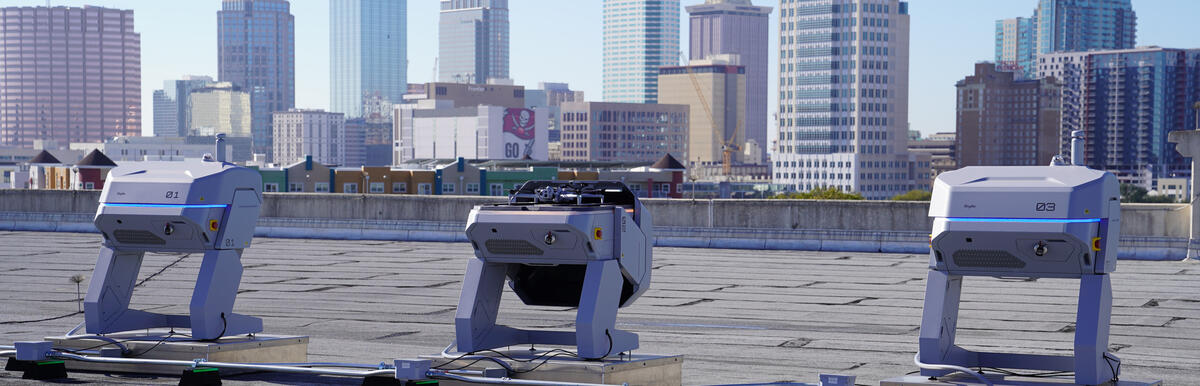
The Tampa Police Department utilizes Drone as First Responder (DFR) technology to arrive at high-priority incidents quickly. By providing real-time aerial intelligence, we reduce response times, de-escalate volatile situations, and ensure the wellness of the community and the responding officers.


DFR Program Overview 
Benefits & Uses
Missing people, imminent danger to life/property.
Detecting weapons or hazards before officers arrive on a scene.
Identifying if a call requires a large response or can be handled with fewer resources.
Gunshot detection response, suspect tracking, or search warrants
Providing real-time information to supervisors to better prepare for, and manage, incidents without additional escalation.
Safety for crowds of 50+ (parades, festivals, sports).
Accident reconstruction and traffic management (*note: Citations are never issued from drones).
DFR FAQs
This DFR FAQ section is designed to provide clear, direct answers regarding public safety, privacy protections, and operational oversight to ensure you are informed about how this aerial technology is used to enhance emergency response.
It is a system where drones are launched primarily following a 911 call. They often arrive on-scene minutes before ground units to provide a live tactical overhead view. In the pilot phase, this program is being utilized in the Ybor and Downtown areas.
No. DFR is a tool to make police response more effective. It provides officers with information so they can respond more safely and efficiently.
Drones bypass traffic and terrain to provide instant information. This helps us locate suspects or missing people faster, de-escalate incidents with better data, and clear "false alarm" calls without tying up patrol officers.
No. The program is reactive, not proactive. Drones as First Responders are primarily launched in response to specific emergency calls. They do not conduct random patrols or "surveillance flights" over residential areas.
No. Department policy and Florida State Statute 330.411 strictly prohibit the weaponization of any drone. They are used exclusively as a tool for situational awareness, improved public safety, and aerial observation.
No. Our DFR drones are not equipped with facial recognition software. They are used to observe general activity and provide a "bird's-eye" view of an emergency scene.
No. Tampa Police Department policy and Florida law strictly prohibit using drones for surveillance on private property. Our cameras default to a horizon view as they respond to the scene. They are then pointed at the incident scene, not into private residences.
DFR Pilots fly at high altitudes to the scene and focus cameras only on the incident. Our policy prohibits recording areas where there is a reasonable expectation of privacy (like backyards or windows) unless authorized by a warrant or life-safety emergency.
Yes. All pilots are FAA-certified. Drones feature automated "return-to-home" safety protocols and collision-avoidance technology. Flights are grounded during severe weather to ensure public safety.
All footage is stored in a secure, encrypted evidence system, similar to Body-Worn Camera (BWC) data. It is only accessible to authorized personnel for official investigations and is deleted according to state retention laws if it contains no evidence.
30 days for routine flights, then it is deleted according to state retention laws if it contains no evidence.
If the video is evidence in a crime, it is kept according to standard evidence retention rules.
We maintain a Public Flight Dashboard. You can visit our website to view the date and time of the flight, and the type of emergency call that prompted the launch for the last 30 days.
Meet the Fleet
Every TPD DFR pilot has completed:
- FAA Part 107 Certification: Federal licensing for commercial drone flight.
- 40-hour training module focused on simulator-based drills and real-world tactical de-escalation scenarios.
- Specific training outlined below
Skydio X10: Our primary DFR unit. It uses AI-driven obstacle avoidance to fly safely in complex urban environments.
- Model: Skydio (with Autonomous Flight Technology)
- Weight: Under 55 lbs
- Power: Electric/Battery
- Sensors: 4K Video, Thermal Imaging, GPS.
- Thermal Capabilities: Allows us to find missing people in total darkness by detecting heat signatures.
Tampa Police Department ensures every DFR pilot is a certified professional.
- Pilot Certification: Every TPD drone pilot holds a current FAA Part 107 Remote Pilot Certificate.
- Advanced Training: Beyond FAA basics, DFR pilots complete Skydio Academy and simulator training for autonomous response.
- Monthly Proficiency: All pilots must log a minimum number of flight hours and scenario-based drills every month to maintain active status.
- Quarterly Review of all training to ensure quality assurance.
- Federal Oversight: All training records and flight logs are subject to audit by the FAA.