Bayshore Boulevard Sidewalk

PFAS

Protecting drinking water quality remains our #1 priority

For over 100 years, the Tampa Water Department has delivered safe, clean water that meets all federal and state regulatory standards. In April 2024, the Environmental Protection Agency (EPA) issued regulatory standards to manage the risk for a group of man-made chemicals in drinking water called PFAS (Per- and polyfluoroalkyl substances). 

After extensive monitoring and review, EPA has set drinking water regulatory limits for six PFAS chemical compounds:

  1. Perfluorooctanoic acid (PFOA) - has been used to make Teflon and other similar chemicals
  2. Perfluorooctane sulfonate (PFOS) - has been used to make stain repellents like Scotchgard™ and fire-fighting foams
  3. Hexafluoropropylene oxide dimer acid (HFPO-DA) or GenX
  4. Perfluorononanoic acid (PFNA)
  5. Perfluorohexanesulphonic acid (PFHxS)
  6. Perfluorobutane sulfonic acid (PFBS)

Quick facts about PFAS, a human-made contaminant

PFAS (Per- and polyfluoroalkyl substances) is a large family of compounds that include up to 5,000 chemicals. Since the 1940s, PFAS compounds have been widely used in the manufacturing of carpets, clothing, fabrics for furniture, paper packaging for food, and other materials including Teflon-coated products. They are also used in firefighting foam and in industrial processes. 

The EPA confirms that most people are exposed to these chemicals through a variety of consumer products, such as fast-food containers/wrappers, pizza boxes, personal care products, nonstick cookware, stain-resistant coatings used on carpets, and upholstery, and more. Drinking water can be an additional source of exposure in communities where these chemicals have entered the water supplies.

Over the years, many companies have chosen to voluntarily halt the production and use of certain PFAS compounds. In fact, most uses of PFOA and PFOS were voluntarily phased out by U.S. manufacturers in the mid-2000s. However, some of these chemicals are still in use for limited purposes.

In January 2024, EPA finalized a rule that prevents companies from starting or resuming the manufacture or processing of PFAS that have not been made or used for many years without a complete EPA review and risk determination.

No.

One common concern is that PFAS generally breaks down very slowly, meaning that concentrations can accumulate in people, animals, and the environment over time. 

Wheel of products that contain PFAS

Drinking Water Standards for PFAS

In April 2024, EPA issued the first ever national, legally enforceable drinking water standards to protect communities from exposure to harmful PFAS. 

The table below shows the maximum contaminant level (MCL), or limit, for each of the six regulated PFAS chemical compounds that water utilities must comply with.

*Compliance with MCLs is determined by running annual averages at the sampling point.
Compound Final MCL (enforceable levels)*
PFOA 4 ppt
PFOS 4 ppt
PFHxS 10 ppt
PFNA 10 ppt
HFPO-DA (commonly known as GenX Chemicals) 10 ppt
Mixtures containing two or more of PFHxS, PFNA, HFPO-DA, PFBS 1 (unitless) using the Hazard Index

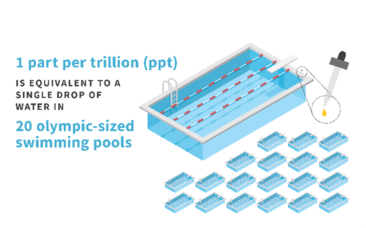
1 ppt - Olympic pool reference

For perspective, one part per trillion is the equivalent of a single drop of water in 20 Olympic-sized swimming pools, or one second in 32,000 years. In other words, it’s a very, very small amount.

The MCLs are so low that they are just barely within the detection level that scientific instruments can currently measure. 

What is the Tampa Water Department doing about PFAS?  

The Tampa Water Department has taken a proactive approach to address concerns over PFAS in drinking water. The department has identified Suspended Ion Exchange (SIX), a pioneering technology, as an approach that can help ensure that the department meets PFAS regulations. 

As part of this effort, Tampa is planning the construction of a SIX treatment facility in the coming years. Once completed, it is expected to be the largest facility of its kind in the world, underscoring the city’s commitment to delivering safe, high-quality drinking water.

To learn more about SIX technology and how it works, watch the video below.

The Science Behind S.I.X.